

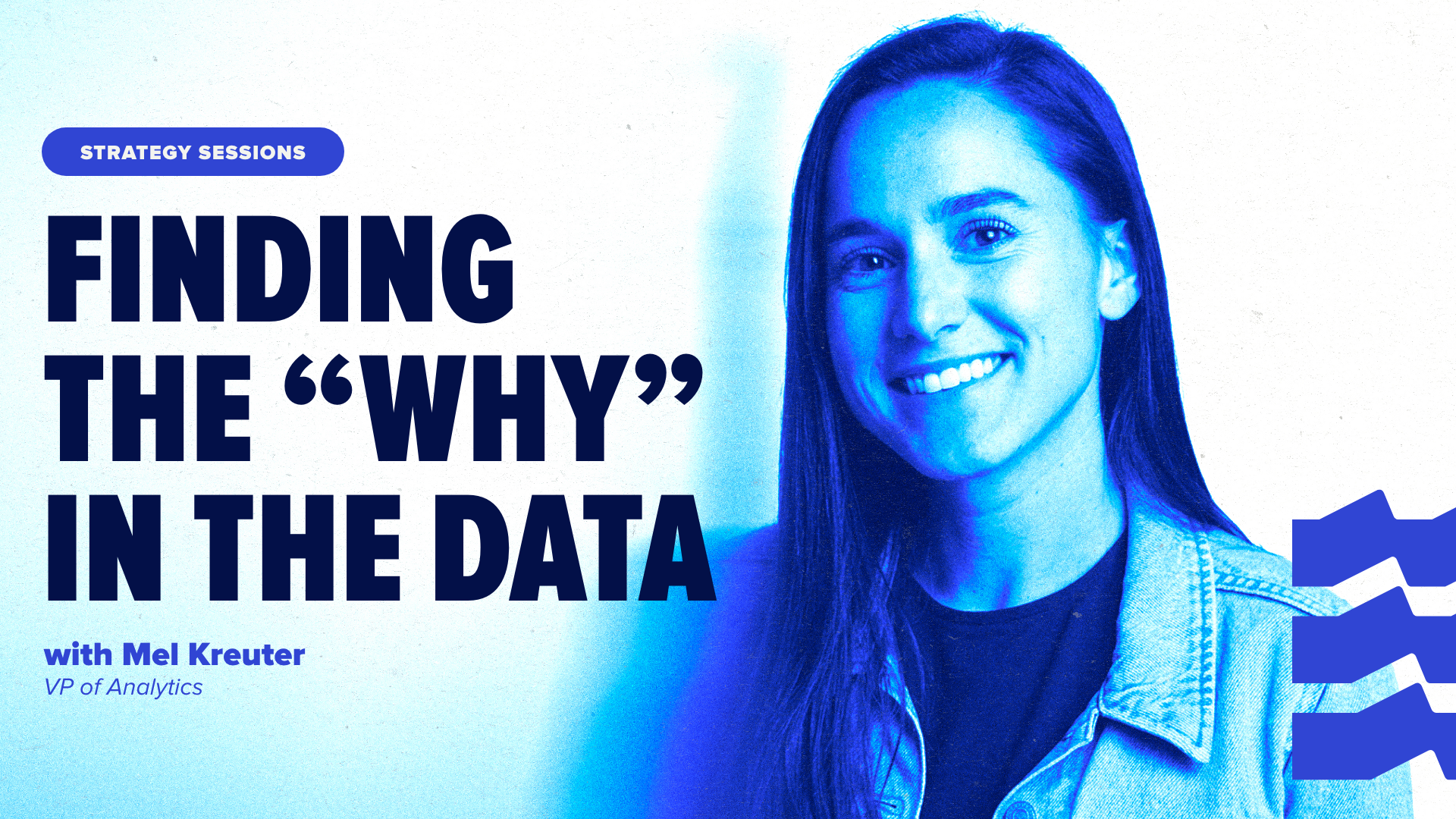
Strategy Sessions: Finding The “Why” In The Data
with Melissa Kreuter, VP of Analytics at 85SIXTY
Recorded: March 20, 2026
Participants: Brian Perkins (Director, CRM Marketing, 85SIXTY) and Melissa Kreuter (Head of Analytics, 85SIXTY)
When most analysts look at data, they look for numbers.
Melissa Kreuter, our VP of Analytics looks for stories.
Melissa oversees the end-to-end journey of our client data. From setting up tracking and engineering data warehouses to extracting the actual learnings.
In this edition of Strategy Sessions, I sat down with Melissa to address the gap between reporting and true insight, why business leaders are asking the wrong questions, and how AI is changing the future of analytics.
Meet Melissa Kreuter, VP of Analytics
Brian: To kick things off, how did you originally find your way into the analytics space?
Melissa: So analytics is kind of funny. I knew I liked math, but I also knew I liked art. So I actually started in architecture for education, and then I quickly learned there’s not enough math in that. So I ended up in actuarial sciences, which is analytics for insurance. That was a bit less interesting than advertising, I’d say.
Then, I made my way here. I like analytics specifically because I feel like it’s the merging of math and art. There’s an art to the storytelling, but there’s also, you know, technical math and stats skills that you need to get there.
Brian: That’s a great point. I don’t know that people always recognize the art that goes into your field.
What is the biggest disconnect for people who aren’t in the analytics discipline? What do they misunderstand about your work?
Melissa: People tend to think that we can find answers without a question. They’ll ask, “What’s working?”… I can tell you generally what’s working, but what were you trying to make work? What was the new thing you were running, and what were you expecting to happen?
I mean, there’s so much data these days, right? You can’t look at everything.
It really helps when you have a true business question you are trying to answer or a hypothesis you are trying to prove, but a lot of people just expect you to have the insights ready to go.
Reporting Vs. Insights
Brian: That segues really well into our main topic today. In practical terms, what is the actual difference between “reporting” and “insights”?
Melissa: In my mind, reporting is step one of the process, right? It’s collecting the numbers, understanding the trends, and showing that your conversion rate was 3% last month and 3.4% this month.
Insights are the next step. It’s shifting the conversation from data points, tables, and graphs to more actionable, and often qualitative thinking. This is the step where we ask and try to answer questions like: “what do these numbers mean?”
“Why do I care about this?”
At the end of the day, nobody actually cares about how many impressions they had last month, because that isn’t a true business metric. Unless you relate data to reality, your strategy, or your revenue goals, it’s meaningless.
Brian: Totally. I see that in my field as well. But I wonder, if insights are so crucial, why do we see so many teams and organizations stop at the reporting stage?
Melissa: Reporting is first, and it’s easier. It’s just collecting numbers and doing math equations. The insight stage is much harder. You don’t necessarily know why something happened, so you have to make assumptions, form a hypothesis, and run incrementality tests to see if what you think is happening is real. Because it takes more advanced team members to accomplish, it often gets left for someone else to do.
“Unless you relate data to reality... it's meaningless.”
How To Ask Better Questions
Brian: How can companies start bridging that gap and operating more proactively?
Melissa: It starts with finding the question. Often, an analyst is given a task to build a highly granular report, but they aren’t told why it’s needed or who originally asked for it. The most helpful thing you can do is bring your analytics team into those initial conversations. An analyst needs to understand how the decision-makers are thinking, what drives their decisions, and what levers they can actually influence.
Brian: So we need analysts involved in those earlier conversations?
Melissa: Right. Being present there and having a voice in the room is really helpful for an analyst. The key to insightful data and reporting is understanding how the decision-makers are thinking.
Brian: What kinds of questions should marketing teams be asking their analytics partners to get better results?
Melissa: Ask questions that get you an action. Take the metrics out of it. Instead of asking, “What’s my click-through rate?” ask, “Is my creative saturated?” or “Are other creatives working better for certain audiences?”. If you ask a higher-level question, you might get all those smaller answers without having to ask them individually.
Instead of asking where you can increase your budget, ask: “What’s the best way to spend our next dollar?”. You don’t just need to know where there’s room for money; you need to make sure every dollar is contributing the best to your bottom line.
What can happen in some organizations is that they think they know what numbers they need to answer their question… but there are a lot of ways to answer questions.
So you might not be getting your full picture, and you could get a lot more information if you just ask the original question.
For example, imagine asking “Is my creative saturated?” instead of “What’s my CTR?”…
The first question calls up a lot of nuanced research. We’ll look at the data from multiple viewpoints. We’ll develop our own questions and answers that ladder up to the original, high-level question. The response will be detailed, nuanced, and probably shed light on things you didn’t think about.
The second question just returns a number, because an analyst probably doesn’t know why you’re asking the question.
Looking Ahead: AI in Analytics
Brian: How is AI interfacing with your work nowadays? I’m sure you’ve seen and used a ton of different tools by now.
Melissa: Well… It’s about how you ask the question, right?
In the early days, we tested several different tools, and we got pretty inconsistent results.
That’s actually why we’re building our own tool internally, Brand Gravity, which is a conversational analytics tool.
Brand Gravity acts sort of like ChatGPT, but it also has access to a client’s specific data set. It enables the team to get interesting, actionable information much faster than they typically could.
However, we find that it’s all about how you ask the question. In just the same way that context matters when you’re working directly with an analyst, that same context around decision-making completely informs the sort of result you get back from Brand Gravity.
As the field develops, I think we’ll see an increase in “AI engineers” who simply know how to speak well to AI. AI is going to revolutionize the industry, and it will require analysts to advance their skill sets to meet that change.
Brian: Awesome. Very insightful. I really appreciate you meeting up with me.
Melissa: Happy to. Thanks for thinking of me!


Leave a comment:
You must be logged in to post a comment.