

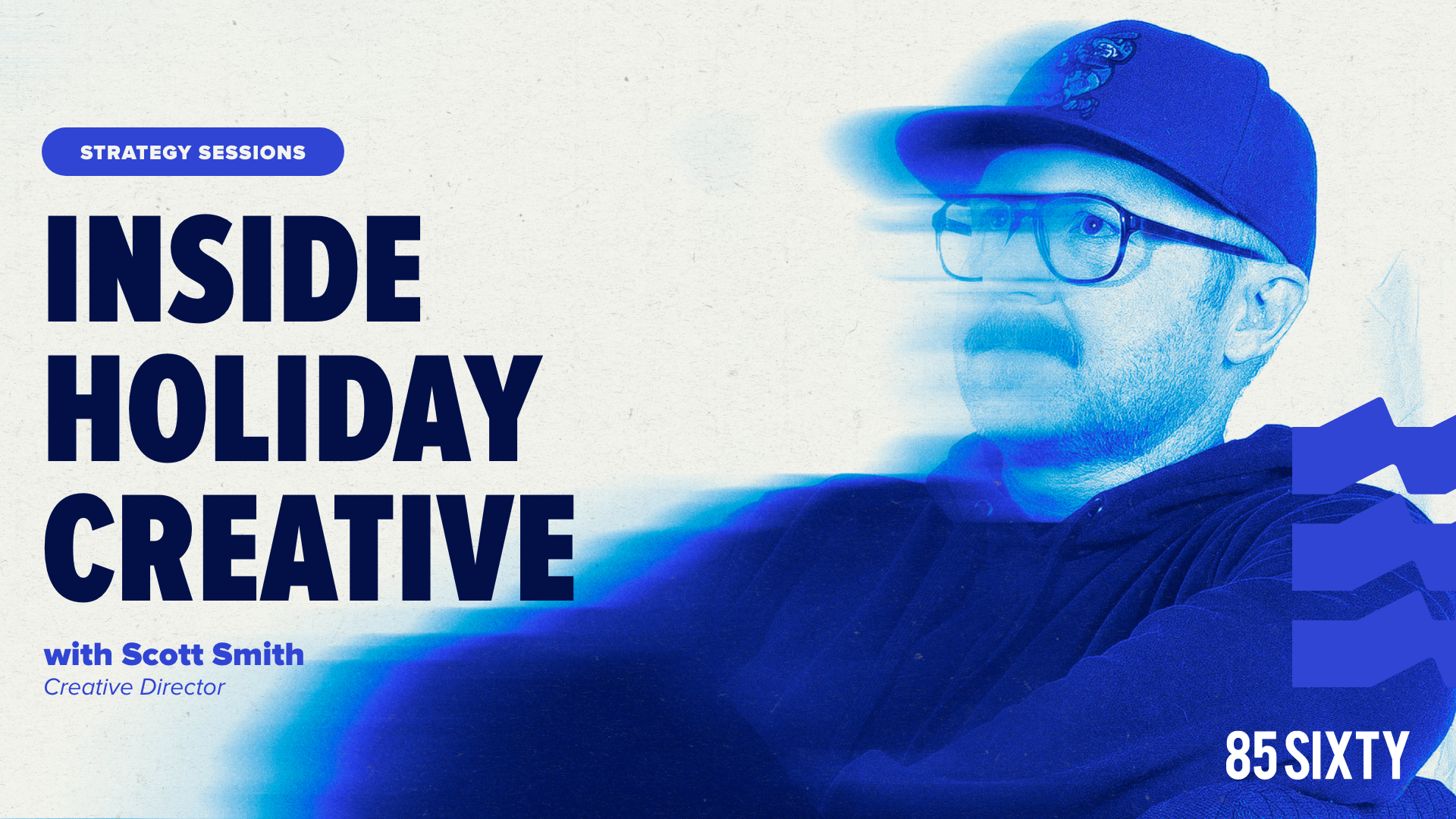
Strategy Sessions: Inside Holiday Creative
with Scott Smith, Creative Director at 85SIXTY
Recorded: December 5, 2025
Participants: Brian Perkins (Director, CRM Marketing) and Scott Smith (Creative Director, 85SIXTY)
For the first edition of Strategy Sessions, we sat down with 85SIXTY’s Creative Director, Scott Smith, to talk about his role, how creative is evolving inside a performance-driven agency, the collision of AI and advertising, and what this year’s holiday ads are getting right (and very wrong).
Meet Scott Smith, Creative Director
Brian: To kick things off, can you tell our readers who you are and what you do at 85SIXTY?
Scott: I’m the Creative Director at 85SIXTY. I lead a team responsible for shaping the ideas and stories that help brands earn attention, not just hope for it.
My role sits at the intersection of strategy and storytelling. Uncovering a brand’s emotional center and turning it into creative that performs in the real world. Day to day, I’m guiding campaigns, brand positioning, content shoots, and the systems that make great creative repeatable.
In short: I help brands build gravity, and I help our team capture it.
Brian: How do you explain that to someone outside the industry, like a family member?
Scott: I usually tell them: brands have something to say, and we help them communicate their message in a lot of different ways. Then we figure out how to get that message in front of the people.
How the Creative Practice is Evolving
Brian: Is there anything you’ve been working on lately that you’re especially excited about?
Scott: I’m excited about how our creative practice is evolving.
We’re building faster, more integrated systems: tighter collaboration with media and analytics, clearer frameworks, and a much more intentional approach to everything we make. Being part of a data-driven agency gives us a rare advantage. We get objective feedback on every idea.
At first, coming from a strictly creative agency, that felt exposing. But once you embrace that feedback, it becomes a superpower. The data gives you a target, not a critique.
We’re also developing new AI tools to help us evaluate creative direction and move faster without losing intention. On the client side, we’re producing some of our most ambitious, performance-informed brand evolutions yet, especially in supplements/CPG and destination marketing.
“People scroll before they think.”
Brian: You mentioned “more integrated systems.” What does that actually look like in practice?
Scott: The traditional model was: make a 30-second spot and build everything else off of that. The landscape doesn’t work like that anymore.
People are buying on TikTok Shop, watching live selling, using TikTok instead of Google to search. Every platform has its own expectation of what content should feel like.
If you don’t show up native to the platform, you get scrolled past instantly. I heard a line I really like: “People scroll before they think.” If something looks like it doesn’t belong there, or looks obviously like an ad, it never even makes it all the way through their brain before they scroll.
So integration for us is: carry a coherent brand message while making the format and style feel right for each channel, instead of just cutting down the same master asset and hoping it works everywhere.
Brian: Looking across your career, is there a through-line in your work or philosophy?
Scott: Yeah. The through-line is clarity over cleverness.
Early on, I chased polish. Now I chase relevance, emotion and performance. The work has become less decorative and more intentional. Every element has to earn its place and serve a purpose.
I’ve always gravitated toward building the system underneath the idea, the messy middle where a brand needs direction or a process needs rebuilding.
The biggest shift for me was realizing creativity isn’t magic. It’s a system: insight, structure, testing, and craft working together.
And attached to that is a hard lesson every creative eventually learns: the work isn’t yours. The brand owns it. Your job is to understand the brand so deeply that you create like it, not like yourself.
Brian: That resonates a lot with what we see in email and CRM, too. In the past, people have tried to build the perfect combination of copy, creative, and timing, but in practice it’s systems, infrastructure, and scale that do the real work. How do you think about that in advertising?
Scott: It’s the same idea. It’s unfortunate that we often judge a single piece of creative on hard KPIs. “How many purchases did this one asset drive?”
In reality, it’s the whole system working together. There’s rarely a single headline that makes people desperately need to buy something.
What actually works is the long-term effort: people recognizing who your brand is, what you stand for, and then being nudged to purchase over time.
To use a baseball analogy (I love baseball): there aren’t a lot of grand slams. You shouldn’t step up to the plate trying to hit one. You go up trying to hit base hits and win the game. An ad, an email, a video, they’re all just parts of an ecosystem, not the entire journey by themselves.
Brian: If you had to give one piece of advice to creative teams, what would it be?
Scott: Don’t fall in love with your ideas. Fall in love with the problem.
There’s always a problem you’re solving. It’s not just about making things pretty. The moment you over-identify with a concept, you stop hearing what the audience and the data are telling you.
Curiosity and flexibility will take you further than attachment.
The most meaningful lesson I’ve learned is that creatives aren’t the owners of the work. Ego kills clarity. When you pull yourself out of the equation and think like the brand, the work becomes sharper, more intentional, and far more effective.
Brian: What’s been your biggest challenge as a Creative Director, both historically and today?
Scott: Early on, the challenge was building a creative discipline inside a performance-driven agency. I had to prove that brand thinking and data could coexist, and that when they do, both get stronger.
Creating the systems, trust, and shared language for that took a long time.
Today, the challenge is pace. Brands need more creative, in more formats, with shorter shelf lives. Different platforms, different executions, we have to iterate constantly.
My role now is balancing speed with substance: using better systems, smarter tools, and AI-enabled workflows so we can move fast without losing intention.
On AI in Creative
Brian: You mentioned AI. What’s your take on where it sits in creative right now?
Scott: When AI hype took off, there was this promise that it would make us stronger, give us better ideas. Honestly, it was an uncomfortable moment.
So far, AI has shown it can produce a lot of content, but not necessarily good content. Yes, people use it for creative production. Yes, they can generate endless ads.
But when everyone is playing the scale game, you should play a different game. Quality over quantity. Intention over volume.
My worry is consumer fatigue. If we keep serving people trash, low-effort AI ads, they’re just going to check out. We’re already seeing that with things like TikTok and UGC. People don’t want brands telling them how great they are. They want qualified recommendations from other real people.
There’s a weird side effect here: the more AI “slop” fills feeds, the more valuable truly human, thoughtfully made work becomes. It feels like a breath of fresh air.
Brian: How do you personally use AI without letting it take over the creative?
Scott: I try to make AI my partner in the things I’m not great at.
It can speed up processes and level the playing field in weaker skill areas, but it can’t do the job for you. You still have to feed it, edit it, and make the actual decisions. You’re still the editor.
2025 Holiday Ad Creative
Brian: Let’s get into holiday ads. When you look at this year’s work, what stands out?
Scott: A couple of things.
First, there’s a big reliance on nostalgia and celebrity casting. You see brands basically saying, “Remember this movie? Remember this star? Give us your money.” A lot of it feels lifeless, even in campaigns that are technically well-crafted.
Second, there’s this dynamic where some brands clearly just spent the whole budget on a famous face instead of a strong story. You see it in things like the T-Mobile spots. It’s “let’s drop celebrities into a generic script and call it a day.” It’s a very expensive shortcut.
Brian: At the same time, some brands are using nostalgia well. What’s an example that actually landed for you?
Scott: Home Instead’s “Home But Not Alone” is a great example.
It uses Home Alone in a smart way for in-home senior care. Millennials grew up with that movie. I can basically recite it. Now a lot of us are in the life stage where we’re starting to think about care for our parents.
So that nostalgia isn’t random; it’s relevant. They didn’t over-explain or cram every proof point into the spot. It’s subtle, it’s emotional, and it speaks to exactly the right audience at the right time.
Brian: Let’s talk about Coca-Cola’s AI holiday ad, because that one’s been… divisive.
Scott: Honestly, I just find it deeply disappointing.
I’d love to talk to someone at Coke about what the intent was. It’s such a strange choice for a brand that has historically set the bar for emotional holiday storytelling.
The animals, the world, the animation; it all feels off. I hope people recognize it for what it is: a cost-saving exercise dressed up as innovation.
Could it simply be a provocation piece, made just to get people talking? Maybe. It’s getting more comments than a “normal” Coke ad ever would. But to me it reads as a brand trading away craft and warmth for a tech stunt.
Brian: On the other end of the spectrum, you mentioned loving Apple’s “A Critter Carol.” Why?
Scott: Apple’s spot does almost everything right.
It’s got this Jim Henson-ish puppet world that’s intentionally rough around the edges, handmade, imperfect, full of personality. The song is funny and a little dark in a charming way.
Most importantly, the intention is clear: it’s a story about friendship and creativity that happens to be shot on iPhone. I watch a ton of YouTube and almost never sit through ads, but that one, I’d watch all the way through and share with people.
The contrast with Coke is huge: one feels like it was made by people who care; the other feels like it was made by a prompt.
Brian: Another one that came up in your notes was Uber’s holiday spot: the emotional “going home” film. You liked it but had reservations.
Scott: It’s a beautiful piece of film. I was legitimately holding back tears.
But from a brand standpoint, Uber is barely in it. The Uber moment is the connective tissue between airport and home, but it doesn’t really communicate a clear benefit or differentiator.
So as a short film: great. As an Uber ad: I’m less convinced. That’s a pattern you see with some big holiday productions: huge emotional arc, massive budget, but a very thin link back to what the brand actually does.
Looking ahead to 2026
Brian: As we wrap up, looking at 2026: what do you think the next year of creativity looks like in our industry?
Scott: I think we’ll see more chaos and more clarity at the same time.
There’s going to be a flood of AI-generated content, a lot of “AI slop”, and at the same time a counter-movement toward intentional, human-made work.
The brands that win will be the ones that put effort into getting the right messages out, not just the most messages. They’ll use AI as a tool, not a crutch, and they’ll double down on clarity, relevance, and authenticity, especially in things like UGC and creator content.
The creators who stand out will be the ones who feel the most real, not the most polished.
Brian: Scott, this has been super insightful. Thanks for kicking off Strategy Sessions with me.
Scott: Thank you. Happy to be here.
Leave a comment:
You must be logged in to post a comment.