

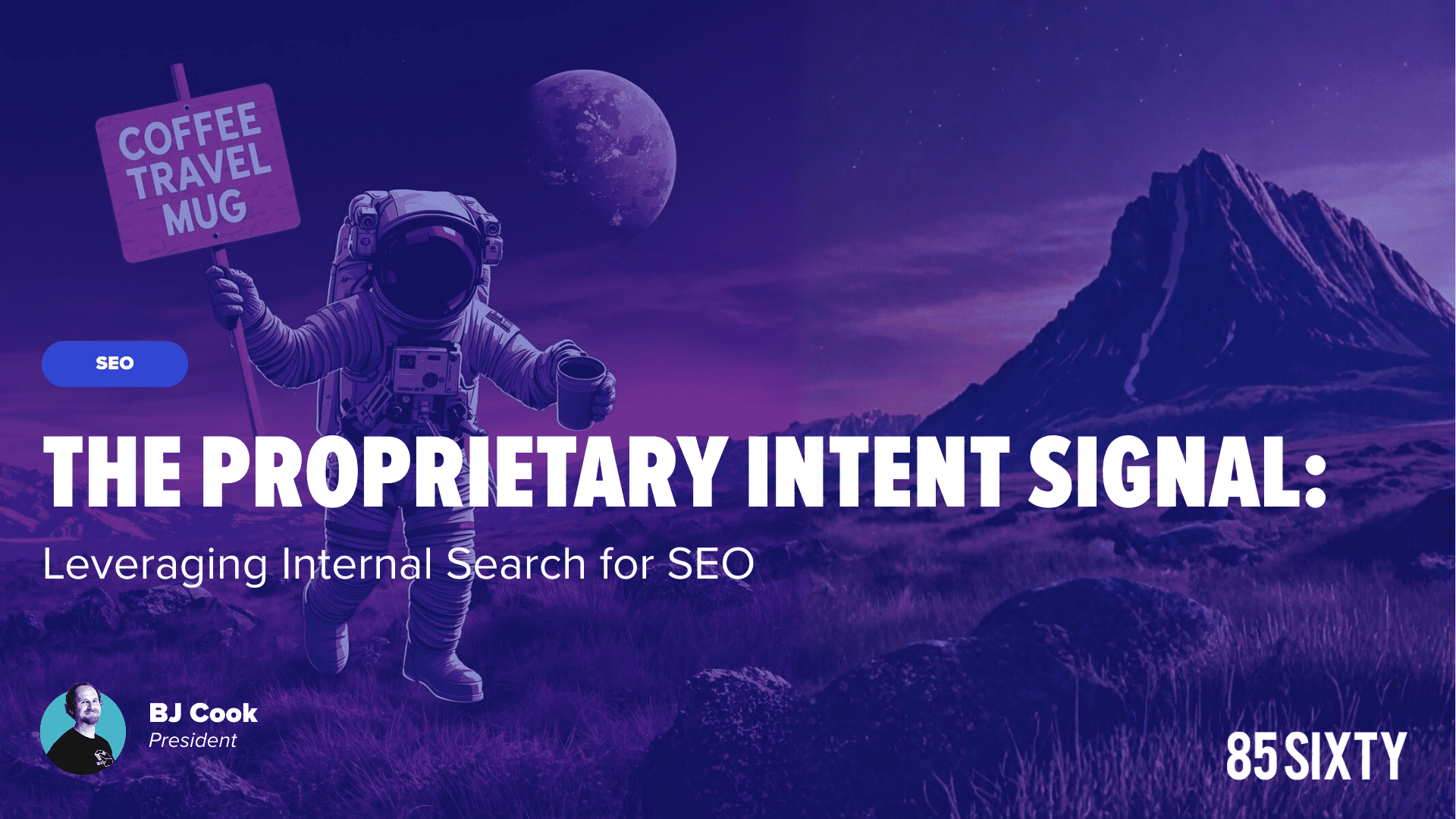
The Proprietary Intent Signal You’re Ignoring: Why Internal Site Search is the Missing Link in Your SEO Strategy
Your customers are telling you exactly what your site is missing. Are you listening, or just relying on third-party estimations?
As an Ecommerce Director, your inbox is likely flooded with pitches promising “AI-driven keyword revolutions” and generic advice about optimizing meta tags. You have budgets to manage, margins to protect, and a directive to drive organic revenue, not just traffic.
You don’t need more noise. You need actionable, proprietary intelligence.
Most ecommerce brands spend thousands of dollars monthly on third-party tools like Ahrefs, SEMrush, and Moz. Now don’t get me wrong, we love all of our tools too. But these tools are really for understanding the broader market landscape. Relying solely on them is akin to trying to understand your customers by reading industry census data, rather than listening to the people currently standing in your store.
At 85SIXTY, we find that the most potent, underutilized SEO asset is already sitting in your website analytics: your internal site search data.
This isn’t about finding a few new blog topics. It’s about leveraging zero-party data to fix systemic semantic gaps, improve critical UX signals that Google monitors, ensure AI readiness and plug direct revenue leaks.
Here is the technical reality of why internal search data is critical to a sophisticated SEO program.
1. The Psychology of the "Hunter" vs. the "Browser"
A user searching on Google is browsing. Their intent ranges from vaguely informational to specifically transactional.
- A user searching on your site is hunting.
They have already navigated to your property. They are mid-to-bottom funnel. When they use your search bar, they are expressing an explicit, urgent need. They are saying, “I am here, I have intent, and your current navigation has failed me.”
If you ignore this data, you are ignoring your highest-intent visitors at the exact moment of friction. From an SEO perspective, if you can satisfy that user without forcing them to use the search bar in the first place, you win.
2. Bridging the Semantic Gap (Taxonomy vs. Reality)
There is often a massive disconnect between how your merchandising team organizes the catalog and how human beings actually speak.
Your ERP and PIM might classify a product under Home Goods > Kitchenware > Beverage Containment.
- But your customer is searching for "Coffee Travel Mug."
If your category pages, H1s, and structured data are optimized for corporate taxonomy rather than natural language intent, you will lose organic visibility for the terms that actually convert.
The Technical SEO Application: Reviewing high-volume internal queries forces a “semantic audit” of your metadata. We use this data to rewrite category H1s and title tags to match the exact vernacular of the customer, aligning your site better with Google’s entity-based search understanding.
3. The "Long Click" and UX Signals
Google has made it abundantly clear that user experience is a key ranking factor. They measure this indirectly through signals like dwell time, pogo-sticking (quickly returning to the SERP), and engagement rates.
- Internal search behavior is a massive indicator of these signals.
- The Negative Signal: A user lands organically on a category page, doesn’t see what they want, uses your internal search, finds the results irrelevant, and exits the site. This is a compounded negative user experience signal that suggests your landing pages aren’t satisfying intent.
- The Positive Signal: A user searches internally, clicks a result, and spends three minutes on a product page. That is a strong engagement signal. (Hopefully they click Add to Cart, but that’s a whole other post about CRO.)
By analyzing internal search exits and refinements, we identify friction points in the user journey that are likely depressing your sitewide organic performance.
4. The "Zero-Results" Revenue Hemorrhage
The single most dangerous page on your website is the “0 Results Found” page.
If 700 people a month search for a specific brand or product category you don’t carry, and they hit a dead-end page, two things happen:
- Immediate Revenue Loss: That high-intent buyer bounces to a competitor.
- SEO Damage: High bounce rates from these interactions degrade domain trust over time.
The Technical SEO Application: We treat “Zero-Result” queries as emergency architectural issues.
- If the product exists but isn’t being found due to spelling/synonyms, we fix the search configuration or add synonym rules.
- If the product does not exist, we don’t let them hit a dead end. We engineer soft landings; redirecting them to a relevant complementary category or guiding them with alternative suggestions (e.g. popular products, categories, synonyms) or being typo-tolerant as our friends at Algolia say or a “Coming Soon” page that captures their email.
Moving from Data to Action
At 85SIXTY, we don’t just export a list of keywords and hand it over. We operationalize site search data into a repeatable SEO framework:
- Data Normalization: We pull 90 days of raw search query data via GA4 or Adobe, cleaning plurals and misspellings to see true volume patterns.
- Intent Classification: We segment queries into transactional (product-focused) and informational (support/problem-solving) buckets.
- Gap Analysis: We cross-reference high-volume queries against your existing site architecture to identify missing landing pages or vocabulary mismatches.
- Execution Roadmap: We translate these gaps into Jira tickets for new PLP creation, metadata updates, and technical redirect rules.
The Bottom Line
Stop guessing what your customers want based on aggregated third-party data. Start listening to what they are screaming at you through your own search bar.
It’s technical, it’s tedious to clean the data, and it requires bridging the gap between merchandising and SEO. But it is also the most profitable SEO work you will do in Q1 2026.
If you’re ready to move beyond basic keyword research and leverage proprietary intent signals, we’re here to brainstorm!

Written by BJ Cook
President at 85SIXTY and outdoor adventure enthusiast


Leave a comment:
You must be logged in to post a comment.